Antique Smith And Wesson Serial Number Lookup

SOLD FOR: $2,210.00
LSB#: 160132WM60
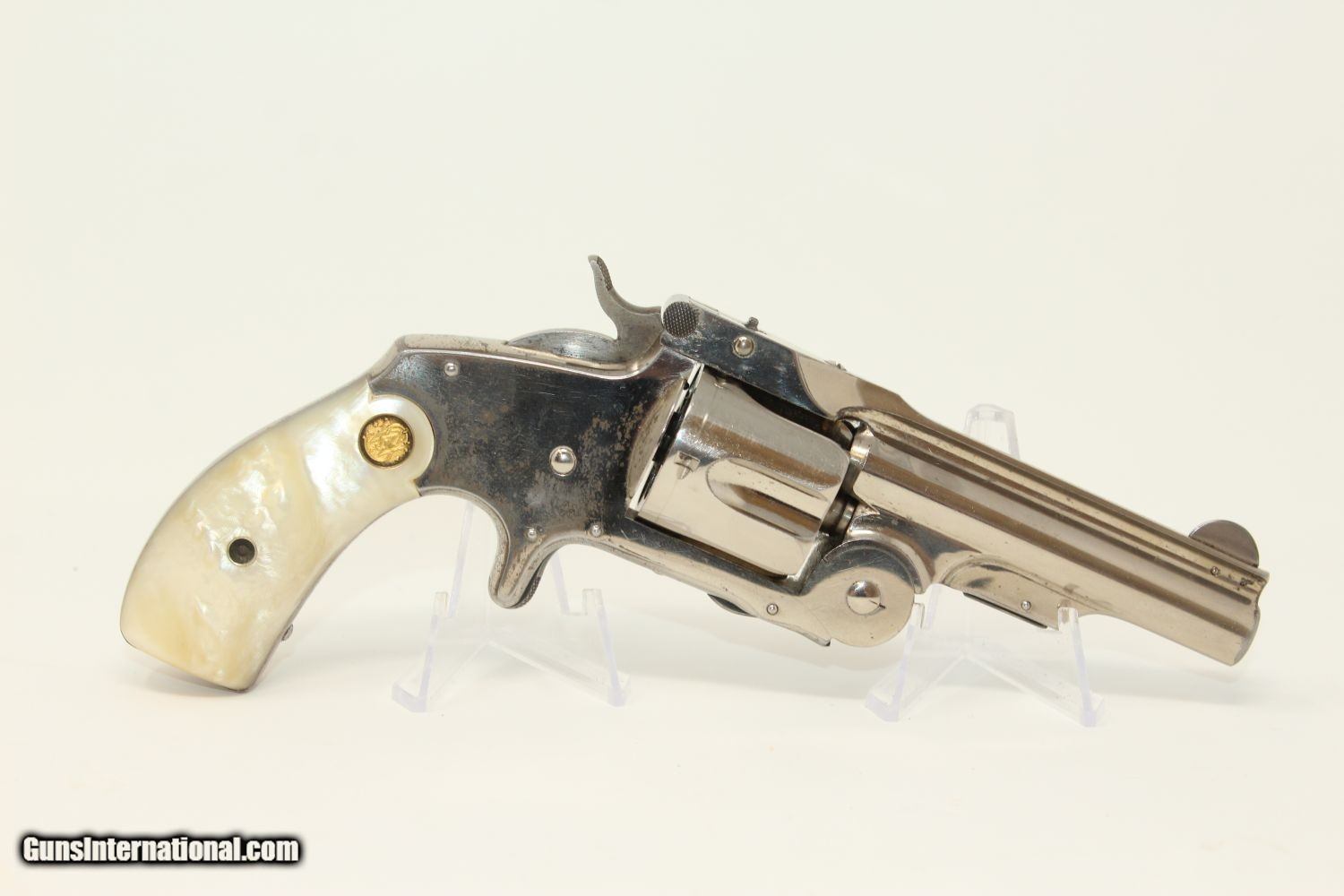
1 day ago Smith and Wesson 32 Cal Double Action Revolver Antique S&W DA Description: This is a nice clean all original Smith and Wesson 32 Double Action Revolver. Antique Pre-1898 serial number under 209,000. This one is an 1880's vintage 4th Model in the 120,000 serial range with all matching numbers on the frame, barrel, cylinder, and latch. Identifying features: This is where to look for the model number (not used until around 1957). Sometimes the serial number is here, especially in later models. Earlier models have them here: S&W revolver names before World War II. Name Caliber Frame.22 Hand Ejector Ladysmith 22 Long M.22/32 Target 22 Long Rifle I.
Make: Smith and Wesson
Model: New Model No. 3 Frontier

Serial Number: 93
Year of Manufacture: 1885-1886 (2072 were built between 1885 and 1908 – “Standard Catalog of S&W” by Nahas)
Caliber: .44-40 Winchester Center Fire
Action Type: 6-Shot, Single Action, Top Break, Automatic Ejecting Revolver
Markings: The rear face of the cylinder, the underside of the barrel latch, the barrel, and the bottom of the grip are marked “93”. The top strap is marked “SMITH & WESSON SPRINGFIELD MASS. U.S.A. PAT’D JAN. 17 & 24. 65. JULY 11. 65 / AUG. 24. 69. APR. 20. 75. FEB. 20 & DEC. 18. 1877. REISSUE JULY 25, 1871”.
Barrel Length: The barrel has a full length top rib and is 6 ½” in length.
Sights / Optics: The front sight is rounded blade pinned to the top strap. The rear sight is a “U” notch fixed to the front of the barrel latch.
Stock Configuration & Condition: The grips are smooth bone one the round butt grip frame that show yellowing with age and small surface cracks, predominately in the left grip. The inside bottom edge of the right grip has a tiny sliver of bone missing and there are two tiny dings in the bottom rear inside corner of the left grip. Both grips are slightly shy of the metal along the front strap but otherwise fit the grip frame well. The grips are in about Very Good overall condition.
Type of Finish: The revolver is nickel plated with a case colored hammer and a blued barrel latch.

Finish Originality: All Original
Bore Condition: The bore is gray and the rifling is sharp. There is moderate erosion in the front half of the bore.
Overall Condition: This handgun retains about 35% of its original metal finish. There is surface loss at the front and rear of the barrel and along its sides, on the circumference of the cylinder, the rear sides of the frame, the backstrap and the top half of the front strap. The bare metal at the front and rear of the barrel and on the top of the frame on the right side of the hammer is developing a dark patina. The exposed metal in the other areas shows a sprinkling of pinprick surface erosion. There are light scratches on the sides of the frame and sideplate, with deeper scratches on the left side of the frame below the rear of the cylinder window, the top of the sideplate next to the hammer, both sides of the frame at the rear shoulder above the grips and at the bottom of the front strap. There are also tool marks around the screw heads in the sideplate with a few tiny dings at the bottom of the backstrap and several small dings along the bottom and right side of the barrel. The cylinder has a drag line through the bolt stop cuts and several small dings scattered around its circumference near the rear edge. The barrel latch shows thinning and light to heavy wear in its knurling while the hammer knurling shows light wear. The screw heads are distressed and the markings are clear. Overall, this handgun rates in about Very Good – Fine condition.

Mechanics: The action functions correctly, including the ejector. It has a smooth extraction cam. The barrel lockup shows just a hint of play while the cylinder lockup shows a fair amount of play. The trigger pull is crisp. We did not fire this handgun. As with all used firearms, a thorough cleaning may be necessary to meet your maintenance standards.
Box, Paperwork & Accessories: None.
Our Assessment: When Smith & Wesson began making centerfire top break revolvers in 1870, they named the large framed .44Model “No. 3”. This was followed by the .38 Model No. 2 in 1876 and the .32 Model No. 1 ½ 1878, based on frame sizes, not date of manufacture. All were first made in single action, and later double action models were added. The No. 3 was made in American, Russian, Schofield and New Model single action sub-models as well as Double Action sub-models. To complicate things even more, there were variants within each sub-model based on caliber and markings. This is a Smith & Wesson New Model No. 3 Frontier Single Action Revolver in .44-40 W.C.F. It is serial number 93 and was made in about 1885, it is one of 2072 pistols produced in this variant. It has the barrel markings of the No. 3 New Model, but with a very low serial number and a 1 9/16” long cylinder, while most of the early New Models had 1 7/16” long cylinders. It has a nickel finish and is in about Very Good condition with 35% of its finish remaining. The barrel lockup is tight but the cylinder lockup shows a fair amount of play. The ejector works properly. This is very nice find for the collectors of Smith & Wesson and other early American revolvers. The top break revolvers were made in so many models, sub-models and variants, it is almost impossible for a collector to acquire one of each, making all of the models collectable. There were only 2072 of the Frontier Single Action variants made, and a few of these were converted to .44 S&W Russian, making this variant even more collectable.
Antique Smith And Wesson Serial Number Lookup For Equipment
iKnife Collector
Hosted by Gus Marsh
Topic: Smith & Wesson Knives
January 9, 2013
The Knives of Smith & Wesson
Smith & Wesson began to examine the knife market in 1972 in an effort to
provide a full line of law enforcement and sportsmen products. President William
Gunn met and discussed designs with Blackie Collins, a knife designer. Blackie
submitted several samples and drawings of various styles of fixed blade knives to
meet the needs of the public. Blackie Collins was an American knife maker who
designed and popularized the assisted opening mechanism and various
automatic knife designs within the art of knifemaking. He is cited by other
knifemakers and collectors as one of the most innovative knife designers in the
world and was an author and the founder of what became Blade Magazine.
Collins died July 20, 2011 in a motorcycle accident near North, South Carolina.
In 1972 Smith & Wesson was approached by the Texas Ranger Commission to
build a commemorative revolver in honor of their 150
th
anniversary. While
attending these meetings, Roy Jenks of Smith & Wesson Collectors Association
and a Smith & Wesson Historian, proposed what could be offered in the way of a
commemorative handgun. At this time, the Commission was also considering the
purchase of a commemorative service knife.
Roy, and John Wilson, a member of the Texas Commission, developed a design,
similar to an early style Texas knife, for a Bowie knife. This pattern was
presented to Smith & Wesson and the Bowie knife, designed by Blackie Collins,
was modified closer to the style originally used and purposed by Mr. Wilson.
Smith & Wesson felt an excellent entry into the knife market would be the Texas
Ranger Commemorative Bowie knife. A package deal consisting of the Smith &
Wesson Model 19 revolver and a Bowie knife was presented. The idea was
accepted, production was initiated, and in 1973 Smith & Wesson announced the
Texas Ranger Commemorative. Production plans called for the manufacture of
8,000 knives cased with a Smith & Wesson model 19. In addition, 12,000
individual knives in their own presentation case were offered.
The Texas Ranger knife, identical to all the early Smith & Wesson knives, was
produced from a forged 440 series stainless steel and handcrafted in a series of
47 different manufacturing operations. Each knife was serial numbered on the top
of the blade beginning at serial number TR1 through TR20,000. The Texas Ranger Bowie knife was the only one marketed by Smith & Wesson in
1973. Plans were made, however, to announce Smith & Wessons entry into the
knife business.
The factory geared up production to manufacture a standard Bowie knife similar
in design to the Texas Ranger; a general-purpose hunting and camping knife with
a 5 inch blade and an emergency equipment cavity in the contoured handle.
This was called the Outdoorsman.
To increase their versatile knife line, Smith & Wesson manufactured the Survival
knife. This also had a hollow handle cavity covered by a solid brass screw-on
cap. The handle was round and blended into a double quillon cross guard for
maximum workability and production. The 5 inch blade had a wide flat spine
and a sharpened false edge. The factory hoped that this 10-ounce knife would
gain popularity with campers and back-packers.
A 3 inch dropped point blade knife, designed for Smith & Wesson by Blackie
Collins, and was offered to the hunter. Its handle was tapered and contoured to fit
into the hand for ease in skinning large or small animals. This was called the
Skinner.
For the individual who did not like fixed blade knives, the factory offered a 3
inch blade lock-back knife called the Folding Hunter. This was a rugged,
handsomely made knife with nickel silver bolsters and sold with a belt sheath.
The factory did not have the capability to manufacture this particular item;
therefore, they contracted with Alcas or Bowen Knife to produce the folding
hunter according to Smith & Wessons specifications. In 1972 Alcas Cutlery
Corporation became a wholly owned subsidiary of Alcoa. Ten years later, a group
of company officers purchased Alcas Cutlery Corporation from Alcoa, taking the
company private. Shortly after the management buyout, Alcas Cutlery
Corporation purchased Vector Marketing Corporation, which became the
distributor of CUTCO products in North America. In 1990, CUTCO Cutlery
Corporation was created to be the manufacturing subsidiary alongside Vector
Marketing Corporation, and the parent company's name was changed from Alcas
Cutlery Corporation to Alcas Corporation.
Bowen Knife was started in 1973 by Walter & Michael Collins. They worked with
Camillus and Alcas in the early days, making many folding and straight knives.
Today the company is much smaller and specializes in making belt knives. Now I
know why I always have to take my belt off when going thru security.
To complete their line of knives, the factory offered the fisherman two fixed blade
knives. These were called the Fisherman Fillet, designed with a 6 inch blade,
and a general-purpose knife with a stiffer 5 inch blade simply called the
Fisherman knife. These seven styles rounded out the Smith & Wessons complete knife line. The
company had put together a group of knives with broad appeal that would offer
advantages of custom-made products but at reasonable prices.
Everything was done to build in quality and custom appearance. The blades were
forged, utilizing 120 plus years of experience in steel forging. The guards and
pommels were hand fitted and silver soldered to the blade. The handles were
hand fitted and made of a special pressure impregnated natural wood called
Wessonwood, which gave maximum durability for a long-lasting life. The edge of
each knife was hand honed by individuals specially trained to complete this
operation and provide a sharp edge blade direct for the factory.
At first, the knife program was well received and sales were promising. In fact,
interest was such that the factory produced a special series of highly decorated
knives called the Collector Series.
This program was announced in 1975 and four knives were offered; Bowie,
Outdoorsman, Survival and Skinner. Each knife was to be serial numbered 1 to
1,000. The blades wee to be acid etched, picturing a game scene, and the guard
and pommels sculptured of sterling silver. Each would be packaged in an
individual presentation case. To enhance and complete this program, the
company planned to offer all four knives in a single case.
The Collector series began in full swing in 1975. Blackie Collins finished the
special knives and the factory quickly wrote orders for production of 1,000 units.
Plans called for the four knives to be built beginning with the Bowie,
Outdoorsman, Survival and finishing with the Skinner. The program was
designed to last for at least a year. Each distributor ordering a knife was to
receive the same serial number in each of the four models. This plan was great,
but manufacturing and vendor problems led to many delays. This caused loss of
interest, and distributors began to cancel their orders. Smith & Wesson found
they were left with many incomplete sets. This distracted from the value of the
program, but for the knife collector it added to the value of the sets that were sold
complete. It is estimated that only 800 complete sets were sold by the time the
program was complete in 1980, five years later.
Late in 1977, Robert Ferraro, an engineer, was requested to develop a new line
of medium of popular priced folding type and new fixed blade knives. This
development took nearly three years from the time the designs were first drawn.
The wait was well worthwhile, for in 1980 Smith & Wesson announced its new
general purpose-folding knife called the Maverick. This knife was available in
both a Clip and Drop point versions.
In 1980, the market saw another Smith & Wesson knife design. This was the
Ultra Thin, a small all stainless lock blade pocket knife. It was just the right size to
slip into a pocket. Immediate success of these two knives caused the factory to discontinue their original line and concentrate on development and production of
a complete new series.
Total discontinuation of the original knife line left the collectors some reasonable
rare knives to seek and add to their collection. As of 1980, the production figures
of all original knives were approximately 108,000 units (this does not include the
Texas rangers Bowie). Here are the production numbers.
Texas Ranger Bowie – 20,000
Bowie 6010 – 15,000
Outdoorsman 6020 – 13,000
Survival 6030 – 17,500
Collector Series – 3,752 (800 complete)
Skinner 6070 – 15, 500
Fillet – 4,500
Fisherman 6040 – 4,500
Fisherman 6050 – 4,500
Folding Hunter 6060 – 35,000
The old knives are now a thing of the past, fine knives built like custom knives to
help Smith & Wesson understand the business. From this early experience,
Smith & Wesson has developed a new series of fixed blade knives called the
American series, which was introduced in 1981.
This series consisted of four knives each having a Posi-Grip handles of rubber
and molded directly onto the blade assembly with a heavy brass hilt to protect the
hand. These were offered in four popular blade styles, called the Large Upsweep,
Small Upsweep, Light Duty, and Heavy Duty.
To round out their line, the factory introduced the Shooters Knife; a slightly
thicker variation of its stainless Ultra Thin, except it has a screw driver blade as
well as a knife blade.
Smith & Wessons philosophy that it is better to develop in house ideas has
resulted in a new style of knife called the Swing Blade. This unique folding knife
was offered in two versions, a sportsman and a boot style. The swing blade
weights 4 ounces and when closed is only 4 inches long and 5/16 inch thick.
The Sportsman features a clip point blade and the Boot a double edge. This new
design enables each operation with just one hand. To open the knife, push the
swing blade and lock protector out in a straight line, then allow the protective blade cover and lock to swing around the blade thus locking the blade into
positive position.
In 1995 Smith & Wesson developed a new 3-blade pocket knife called the
Stockman. The first year, the master blade was marked “First Production Run,
1995. The current productions are all Special OPS and Tactical knives.
A search on eBay for “Smith & Wesson Knife” returned 3,990 items. A search on
the same site for “Smith & Wesson Texas Ranger” returned 14 items.
In recognizing the problems they had, Smith & Wesson has refined and
expanded their knife industry. Development of new ideas and products have
enabled them to be a success in the knife business and offer the sportsman a
better series of knives to meet their various needs.
Sources
The Knives of Smith & Wesson by Clarence E. Rinke 1990 (Limited publication of
1,000 books